It is a town consisting of four neighborhoods and a is one of the seven original villages in Tláhuac.
San Andrés Mixquic lies in the southeastern corner, surrounded on three sides by the State of Mexico.
It was founded during the Postclassic period, between 1160 and 1168, on one of the three islets of Lake Chalco. Later, it was conquered by the Mexicas in 1430 and turned into a ceremonial center where prisoners captured from the surrounding areas were sacrificed.
Its name comes from the Nahuatl language, meaning "In the mezquite tree" or "Place of mezquite trees."
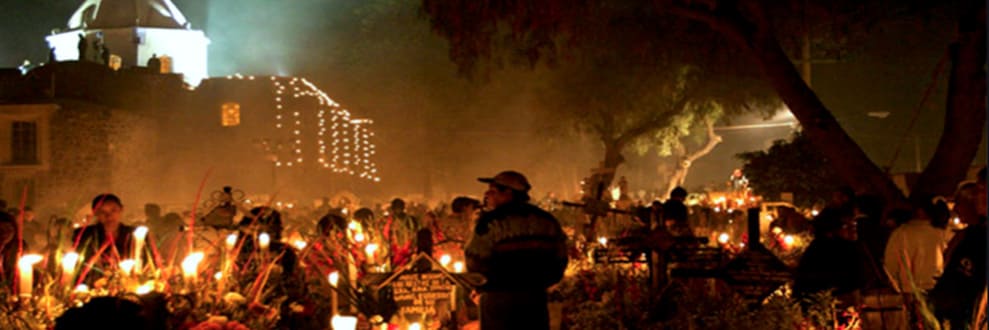
The town gained fame for preserving the Nahuatl ritual during the Day of the Dead festivities. Currently, on November 1st and 2nd, they beautifully decorate all the graves with candles and offerings, attracting thousands of visitors.
San Andrés Mixquic
Among the highlights of Mixquic is the Temple of San Andrés Apóstol, which dates back to 1537, although few elements of the original construction remain. Its facade is modest, and inside, the main altar attributed to renowned artists Francisco Morales and Simón de Pereyns stands out.
Next to the temple, in the Casa Cural, there is a small archaeological zone where a sculpture known as Miquiztli stands out, with a head full of iconographic elements and two faces, one representing life and the other death. Other notable figures include the Mixquic chacmool, which holds a téchcatl or sacrificial stone and two rings used in the Mesoamerican ballgame.







 English
  Español de México